

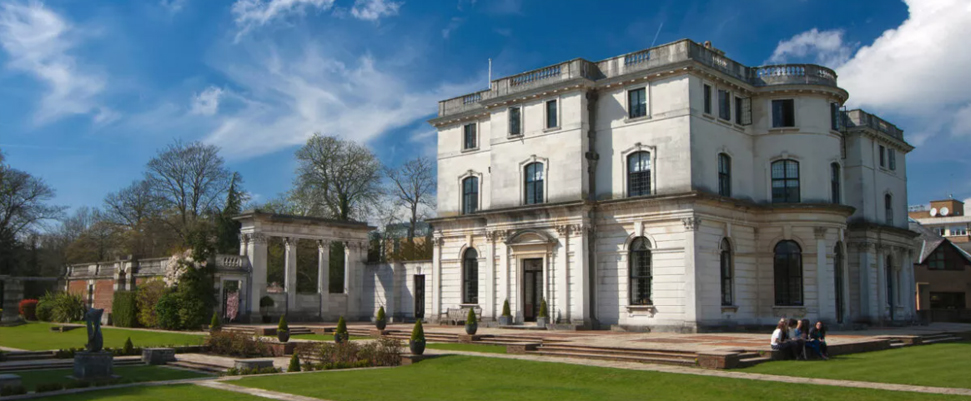
A beautiful image of North London Collegiate School. The house has haunted my waking life and nightly hours since the day I left the School in 1958
I was six years old when my form teacher at North London Collegiate asked us to write an essay on The Things I Love Most. I was sitting in our ugly kitchen in Edgeware, chewing the ends of my long brown plaits and filling my fountain pen with navy blue ink. Autum leaves, I wrote, and the way they crunch beneath my feet. The early-morning scent of newly baked bread from the baker’s shop on the corner. My kitten when he looks into my eyes and washes his face with his paw.
I decided there and then: I was going to be a writer. The search for the right word, exactly and only the right word, would rule my life in whatever shape and form that life took. I taught myself to read at the age of three. By the time I started school I was already writing poems to my Daddy. Every evening in my tiny bedroom overlooking Hale Lane I’d blob inky bits of paper with a song of praise to the sound of the milkman’s horse at dawn or the brightness of the garden robin. Every morning while Daddy was shaving with Imperial Leather I’d read out my offering. ‘Excellent, Valerie,’ he’d tell me, approving his handsome profile, sparkling blue eyes and wave of rich black hair. A hot flannel removed the foam to reveal silky smooth skin. ‘Your best yet. More tomorrow, please. You must keep it up. And I must dash.’
I’d skip back to my desk, pull on my brown tunic and rush downstairs to feed the kitten and swallow toast and marmalade. Then I’d trot off to School. I’d become an observer, a watcher of the skies and rain-washed pavements, a recorder of people’s voices, angry or sweet, a memory bank of the outfits they wore, the noise they made when they sneezed, how they slurped their lunchtime lemonade and chewed with yellowing teeth on a lump of bread.
The Second World War had just ended when I arrived at NLCS. There were echoes of it everywhere: the downstairs cloakrooms seemed full of its haunting shadows. We drank from tin mugs at lunchtime. The Staff were all unmarried women. Some had lost their own true love in the war. Others loathed their profession but it allowed them the only independence they needed to survive. I watched them all, remembering every detail. Miss Hall’s Goodbye Girls handshake was firm but fair. Miss Lewis taught netball and anything else that moved across a court, bouncing around in navy shorts that never looked creased or sweaty. I crashed tennis balls against the gym walls after everyone else had long gone home, wanting to stay while the summer light gradually dimmed around me.
Once out of School, there were men in the streets filling smelly potholes and repairing curbs. ‘They’re all German spies,’ my mother told me. ‘You must watch them like a hawk. Eyes in the back of your head as well as the front. We’re not out of the woods, you know, not by a long chalk. Wars don’t end because one particular nation thinks it’s won the day. Oh dear me, no. They’ll be back. The Russians, the Germans, the Chinese. You name them, they’re going to get us somehow or other. Bacteriological warfare, just you wait and see. They’re hard at it as we speak. You mark my words. If they offer you a drink, turn your back and spit it out. Say Yes when you mean No. Look them in the eye, that’s the only way. You get at the truth, my girl. Our country will always need bloody good spies. But don’t tell your dad. He thinks you’re going to marry a rich Jewish boy from Golders Green.’
I promised my mother I never would. And of course I never did. Nobody ever actually asked me what I believed. By the time I was seven I was scouring every library book for the name of Jesus, fascinated and gripped by the simplicity of the life he led, and his grim determination never to give in, in spite of the odds brutally stacked against him.
Although I was branded a Jewish girl at School, I sang with joy and gusto all the wonderful Church of England hymns and wanted to be baptised a Christian. I invented my own God who always listened to my detailed account of my day and my determination to discover the truth at all costs, however hard. He listened and understood. For my whole life He has been there for me, in tiny Chapel or elegant Church, listening to my perfect-pitch singing voice and supporting my never-ending quest. The truth, the whole truth and nothing but the truth. In all my novels and in all my poems, nothing less than that will ever do.